Easter College, more famously known then as Easter School, was the first private school to open in the Cordilleras in 1906. Founded by the Rt. Rev. Charles Henry Brent, an Anglican Missionary from the United States of America, Easter College takes pride in having been instrumental in strengthening the Anglican faith and promoting education.
The first batch of eight (8) Igorot boys continues to be an inspiration among Easterites. The story of these boys hiking for one week from Bontoc, Mountain Province to Baguio City to be educated, became a classic example in exemplifying their passion for learning.
The teachers, originally composed of Americans, commented on the high intellectual capability of their students, who, indeed, as professionals, excelled in their respective fields. Hilary Clapp (Pitapit), one of the first eight Igorot boys, became a medical doctor and was also appointed a governor of Mountain Province.
In 1909, the school opened its doors to girls through the efforts of Deaconess Anne Hargreaves, a clear indication of respect for equal rights, at a time when gender equality was not a popular battlecry among women. The Easter Weaving Room, now famous for its world-class woven materials and souvenir items, served as training ground for girls for their vocational training.
During the Second World War, the Easter compound was used as a Japanese garrison leading to the temporary closure of the school. But even the ravages of war, leaving only two structures standing, did not stop the school from resuming its operation after the war. By the end of the American colonization, as the national and local administration was slowly filled with Filipinos, likewise, the administration of Easter was slowly handed over to Filipino administrators in 1956.
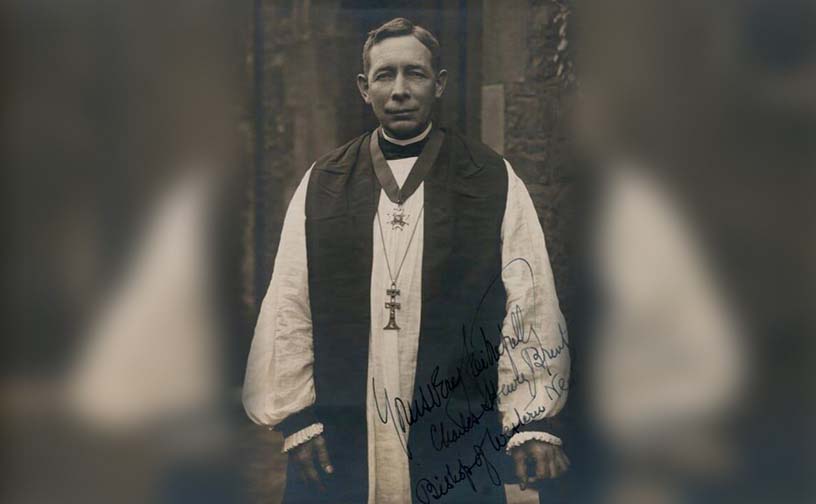 Photo: The Rev. Charles Henry Brent, Founder.
Being the first private school to be established, Easter rightfully claims to have educated not only sons and daughters of American missionaries, servicemen, and government officers. It also catered to neighboring provinces, most especially those coming from the Cordilleras. In fact, it has also produced the first Cordilleran to serve as city councilor in the person of Eugene Pucay, Sr., who, aside from being a great softball palyer and philantrophist, also contributed to the establishment of the Young Men's Christian Association (YMCA) of Baguio and helped establish the Masons of Baguio.
After offering elementary education for 54 years, Easter opened its high school department in 1963. While Easter is known as a school mostly attended by 'highlanders' and Anglicans, it never closed its doors to students and employees coming from any part of the country and those belonging to different religious denominations. At present, it is a hodgepodge of cultures, beliefs and nationalities, after being granted the permit to accept foreign students in all levels.
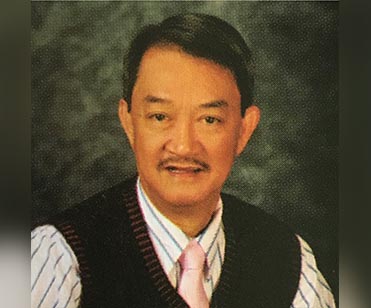
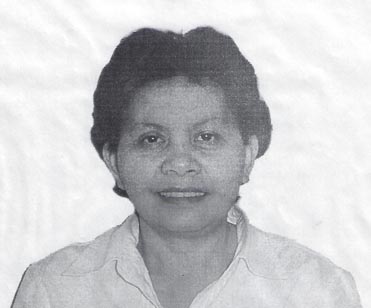
Easter College's basic education program, from its pre-school to high school, has consistently proved its competency, being accredited by the Association of Christian Schools, Colleges and Universities Accrediting Agency, Incorporated (ACSCU-AAI). Year after year of its operation, it aims to surpass its current status and aims for autonomy by continuously improving and developing its programs and physical facilities. Under the administration of Dr. Marilyn Ngales, Easter College's first president, a Special Education (SPED) program was also instituted to cater to children with special needs. This program, also known as Special Action and Rehabilitation for the Handicapped (SARAH) provides education and care to children who are blind, deaf-mute, mentally handicapped and those with learning disabilities.
So that it can continue to educate its graduates, the college department was added in 1995 as a brainchild of Dr. Marilyn Ngales. Education courses were the first to be offered along with the non-traditional courses such as Indigenous Studies, Legal Studies, Environmental Studies, Developmental Studies, and Cooperative Studies. Such non-traditional courses, however, had to give way to courses that were dictated by the industry. In 2003, the Bachelor of Science in Nursing program was offered, which has continuously placed Easter College among the top three performing schools in the Cordillera Administrative Region for its consistent good performance in all Nurse Licensure Examinations since it graduated its first batch in 2007. The Department of Nursing is the only school in Baguio City integrating a Sign Language course, Mountain Search and Rescue, and Water Search and Rescue in its curriculum.
In 2004, Dr. Benjamin R. Yngente, a professor from the Trinity University of Asia was installed second president of Easter College. Owing to his experiences, he introduced major reforms in the college in terms of organizational structure, infrastructure, and recommended for the opening of two new courses - Bachelor of Science in Hotel and Restaurant Management and Bachelor of Science in Business Administration. The college department, on the other hand, has also gained Level II accreditation from the ACSCU-AAI for its Education courses during his term.
In 2010, Dr. Brigitt Santiago, the former librarian, dean, and Vice President for Academic Affairs, was installed as the third president. While continuing the legacy of the past administrations, Dr. Santiago further instituted developments in the college. Under her administration, the Bachelor of Science in Criminology program was opened.
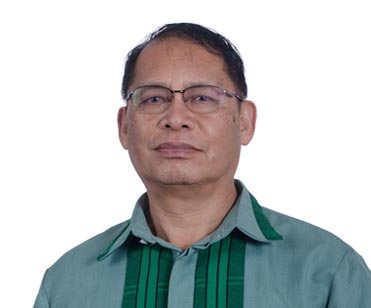
In 2016, Braille Van Bete Reyes, Ph.D. was installed as the Fourth President. He revisited and refocused the legacy of the past administrators by strengthening the continuing programs of the college. He embarks on Income Generating Programs and focuses on the additional benefits for employees that resulted to the improvement of the institution and its stakeholders. He has strengthened the camaraderie with established school associations such as the Alumni, Parents and Patrons, and Benefactors, as well as established the Easter College Former Employees Association (ECFEA). In 2020, Dr. Reyes departmentalized the Lay Training Institute (LTI). Through his initiative, the Board of Trustees approved the creation of the Department of Theological Studies and appointed Allan C. Balalao as its first director. Mr. Balalao worked on developing the department's vision, mission, and goals, as well as its logo, which were approved by the Management Committee. Concurrently, efforts to secure a CHED permit for the program began.
In 2021 up to present, Dr. Cleofe Padalla Kollin, a home grown Easterite and Episcopalian, is the 5th President of Easter College. She was a former Elementary teacher, Student Affairs Coordinator, Elementary, and Senior High School Principal and, Vice-President for Academic Affairs of Easter College.
For 33 years with Easter College, she worked with four (4) college presidents and has gone through different academic functions, activities, achievements, and challenges. To name a few, she led the levelling-up of accreditation status of the Elementary program and the DepEd recognition of the SPED program. She co-authored the Christian Education curriculum of the Elementary level, which is distributed to ECP schools for use. She continuously shares her academic expertise by being an ACSCU accreditor and PEAC certifier. She is also active in various professional organizations like the BC-APSA (now BCAPS), an association of the school principal and administrators in Baguio City, where she was once the Vice President for the Elementary level.
Situated in the outskirts of the city, away from the hustle and bustle of the central business district, Easter College offers an environment conducive to learning as it has maintained an environment-friendly atmosphere with its wide spaces and cool fresh air. Through the years, it has stood the test of time as it continues to stand by its vision statement as "An academic community rooted in the Holy Scriptures, strategically responsive to global and national realities, and significantly contributing to the transformation of its constituents into becoming responsible Christian stewards of industry and community."
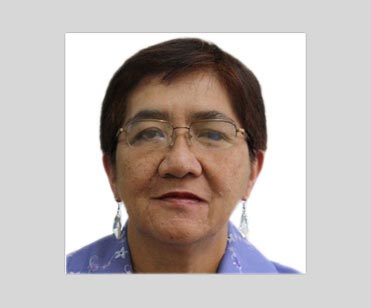
3rd President
2010 - 2016
1st President
1991 - 2004
1970-1991
1967-1970
1963-1967
1957-1963
1951-1956
1946-1951
1941-1945
1938-1941
1929-1938
1928-1929
1926-1928
1924-1926
1920-1924
1916-1920
1915-1916
1911-1915
1907-1911
1906-1907